Galerie Thomas Schulte
Skip to main content
  • Menu
  • Artists
  • Exhibitions
  • Art Fairs
  • News
  • Channel
  • About
  • EN
  • 简体
Cart
0 items €
Checkout

Item added to cart

View cart & checkout
Continue shopping
Menu
  • EN
  • 简体

(Ex)Urban Futures of the Recent Past, curated by David Hartt: Gordon Matta-Clark , POTSDAMER STRASSE,

18 January TO 1 March 2025

(Ex)Urban Futures of the Recent Past, curated by David Hartt: Gordon Matta-Clark

Past Exhibitions In The Gallery exhibition
  • Introduction
  • Installation Views
  • Introduction
    (Ex)Urban Futures of the Recent Past, curated by David Hartt, Gordon Matta-Clark

    Galerie Thomas Schulte presents (Ex)Urban Futures of the Recent Past, an exhibition of films and photographs by Gordon Matta-Clark, at the gallery’s space in Mercator Höfe. Curated by David Hartt, the exhibition engages with critical histories of and experimental approaches to urban space, from a period defined by sweeping transformations that continue to structure the built environment today.


    With an added suggestion of something that no longer is, (Ex)Urban Futures of the Recent Past is a slight modification of the subtitle of the book Megastructure (1976)by Reyner Banham. Banham’s book is a critique of the megastructural movement, the strategies of which were assumed by and gave way to the capitalist restructuration and private development of the 1970s. It refers to a fleeting moment of optimism around the utopian potential of large-scale urban initiatives, in contrast to which Matta-Clark’s more fragmentary approach to city reinvention took shape – as both responded to urban infrastructural decline. 


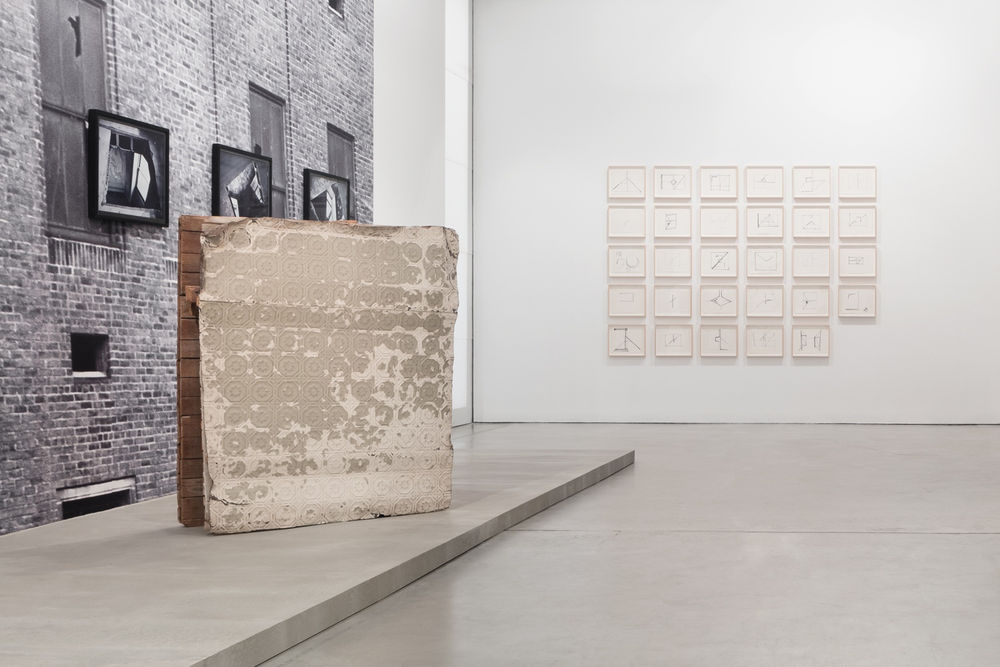
    The black-and-white photographs from Matta-Clark’s series Walls (1972)installed throughout the exhibition are marked by the economic collapse and severe urban decay of the time, depicting abandoned buildings in the South Bronx. In cropped, straight-forward views of wall segments, layers peel back and internal structures are broken down and laid bare. They refer to exposure, or to being exposed: from the demolition process to the camera that preserves this state while underscoring its ephemerality. Their cracked surfaces are split into sections by columns or framed by remnants of decorative moldings that recall floor plans at times, while drifting into abstract stratification at others. The aesthetic of decay is experienced as a process of fading, as well as encroachment. Even though seemingly emptied out, human presence can still be felt: in one photograph, the shape of a void left by a break in a window is vaguely reminiscent of a silhouette.


    Enlivened by human activity and movement, Matta-Clark’s films are projected onto drywall constructions that both partition and open up the space through large mirrors attached to their reverse sides. In one film, Automation House (1972), Matta-Clark’s own use of mirrors alters the perception, functionality and understanding of a space – undoing its architectural logic and coherence. Bodies are fragmented or vanish past the edge of an invisible boundary, reemerging on screen in seemingly impossible continuities that make everyday navigations and cohabitations more difficult to decipher. Framings through windows and doors, along with interactions of shadows and reflections, further destabilize the space – its comings and goings, ins and outs, and the relationships within it, including those between bodies and their movements.


    The splitting of a consistent point of view is extended in the experimental film City Slivers (1976). With the narrow, vertical structure of its images, the film echoes the architecture and fragmented views of Midtown Manhattan that appear in some shots. A moving collage of the city, disjointed perspectives are seen in parallel, as well as through double exposures and layering. Moments of bustling activity are juxtaposed with a lack of visibility in overexposed or blacked out segments – offering glimpses of the city as though through a door’s jamb as it sways between open and closed. Tightly framed sequences of day-to-day motions, such as going through a revolving door, are interjected with panoptical views from atop the World Trade Center. From this vertiginous standpoint that no longer exists, and from which the movement and life below get overlooked, the limits of the body and those of the city are called into question.


    In Open House (1972), perspectives on and relationships to urban space are narrowed in focus. The silent film revolves around a spatial construction of discarded doors and pieces of wood inside of an industrial waste container, which Matta-Clark installed on Greene Street in the New York neighborhood of SoHo – a former industrial area in which artists were claiming space at the time. On the occasion of its opening, the structure is activated through a performance by the artist and a group of friends. We see close-up, dizzying shots of the divided interior and the traces of its construction. Doors are repeatedly opened and closed – no matter which is passed through, the occupants are always both inside and outside. The container’s layout of corridors and small rooms is visible from above through its open roof, allowing the structure and motions within to be juxtaposed with those outside. The performance spills over the top of the container and out onto the street and neighboring buildings. When it begins to rain, both the structure’s openness and its limits are made all the more palpable.


    The boundaries of cities, their fluctuations, and porousness, as well as their corresponding socioeconomic connotations, are reflected here in the term “exurban”. Drawing reference to this area that lies beyond, the space of the exhibition is partially enclosed by raw vinyl Billboards. On the perimeter they display inwardly and outwardly a series of advertisements often found along highways as one leaves the city limits, they are almost milestones marking the outer limits of the urban sprawl that defines much of the American landscape.  In the same way as the Matta-Clark’s 70s marked an exodus from cities to the suburbs, today the exurbs, an unincorporated hinterland,  have become the new frontier where American political freedom and conservativism are being actively contested. The Billboards echo the commodification of the built environment and its subsumption, while set in interplay with the margins, gaps, and vestiges that highlight a more human scale in Matta-Clark’s works. An expansive, though split view is offered – situated at the cusp of past and future, from a vantage point no longer present. 


    Text by Julianne Cordray

  • Installation Views
    Open a larger version of the following image in a popup: Gordon Matta Clark Ex Urban Futures Of The Recent Past Galerie Thomas Schulte Potsdamer Strasse Photo By Graysc De 14
    Open a larger version of the following image in a popup: Gordon Matta Clark Ex Urban Futures Of The Recent Past Galerie Thomas Schulte Potsdamer Strasse Photo By Graysc De
    Open a larger version of the following image in a popup: Gordon Matta Clark Ex Urban Futures Of The Recent Past Galerie Thomas Schulte Potsdamer Strasse Photo By Graysc De 19
    Open a larger version of the following image in a popup: Gordon Matta Clark Ex Urban Futures Of The Recent Past Galerie Thomas Schulte Potsdamer Strasse Photo By Graysc De 8
    Open a larger version of the following image in a popup: Gordon Matta Clark Ex Urban Futures Of The Recent Past Galerie Thomas Schulte Potsdamer Strasse Photo By Graysc De 7
    Open a larger version of the following image in a popup: Gordon Matta Clark Ex Urban Futures Of The Recent Past Galerie Thomas Schulte Potsdamer Strasse Photo By Nick Ash 12S
    Open a larger version of the following image in a popup: Gordon Matta Clark Ex Urban Futures Of The Recent Past Galerie Thomas Schulte Potsdamer Strasse Photo By Nick Ash 13S
  • Works
    • Gordon Matta-Clark City Slivers, 1976 16mm film, 15 min, color, silent Overall dimensions variable Edition 6 of 10, 2 AP
      Gordon Matta-Clark
      City Slivers, 1976
      16mm film, 15 min, color, silent
      Overall dimensions variable
      Edition 6 of 10, 2 AP
    • Gordon Matta-Clark Automation House, 1972 16mm film, 32 min, black and white, sound Overall dimensions variable Edition 5 of 10, 2 AP
      Gordon Matta-Clark
      Automation House, 1972
      16mm film, 32 min, black and white, sound
      Overall dimensions variable
      Edition 5 of 10, 2 AP
    • Gordon Matta-Clark Open House, 1972 super 8mm film, 41 min, color, silent Overall dimensions variable Edition 5 of 10, 2 AP
      Gordon Matta-Clark
      Open House, 1972
      super 8mm film, 41 min, color, silent
      Overall dimensions variable
      Edition 5 of 10, 2 AP
    • Gordon Matta-Clark Graffiti Photoglyph, 1973 Gelatin silver print with hand coloring Diptych Part 1: 59.7 x 173.4 cm | 23 1/2 x 68 1/4 in Part 2: 59.7 x 219.1 cm | 23 1/2 x 86 1/4 in Overall: 59.7 x 392.4 cm | 23 1/2 x 154 1/2 in
      Gordon Matta-Clark
      Graffiti Photoglyph, 1973
      Gelatin silver print with hand coloring Diptych
      Part 1: 59.7 x 173.4 cm | 23 1/2 x 68 1/4 in
      Part 2: 59.7 x 219.1 cm | 23 1/2 x 86 1/4 in
      Overall: 59.7 x 392.4 cm | 23 1/2 x 154 1/2 in
    • Gordon Matta-Clark Walls, 1972 Gelatin silver print Image size: 38.1 x 52.7 cm | 15 x 20 3/4 in Framed dimensions: 55.9 x 71.1 x 3.8 cm | 22 x 28 x 1 1/2 in
      Gordon Matta-Clark
      Walls, 1972
      Gelatin silver print
      Image size:
      38.1 x 52.7 cm | 15 x 20 3/4 in
      Framed dimensions:
      55.9 x 71.1 x 3.8 cm | 22 x 28 x 1 1/2 in
    • Gordon Matta-Clark Walls, 1972 Gelatin silver print Image size: 47.9 x 60.6 cm | 18 7/8 x 23 7/8 in Framed dimensions: 55.9 x 71.1 x 3.8 cm | 22 x 28 x 1 1/2 in
      Gordon Matta-Clark
      Walls, 1972
      Gelatin silver print
      Image size:
      47.9 x 60.6 cm | 18 7/8 x 23 7/8 in
      Framed dimensions:
      55.9 x 71.1 x 3.8 cm | 22 x 28 x 1 1/2 in
    • Gordon Matta-Clark Walls, 1972 Gelatin silver print Image size: 50.8 x 60.6 cm | 20 x 23 7/8 in Framed dimensions: 55.9 x 71.4 x 3.8 cm | 22 x 28 1/8 x 1 1/2 in
      Gordon Matta-Clark
      Walls, 1972
      Gelatin silver print
      Image size:
      50.8 x 60.6 cm | 20 x 23 7/8 in
      Framed dimensions:
      55.9 x 71.4 x 3.8 cm | 22 x 28 1/8 x 1 1/2 in
    • Gordon Matta-Clark Walls, 1972 Gelatin silver print Image size: 50.8 x 58.1 cm | 20 x 22 7/8 in Framed dimensions: 55.9 x 71.1 x 3.8 cm | 22 x 28 x 1 1/2 in
      Gordon Matta-Clark
      Walls, 1972
      Gelatin silver print
      Image size:
      50.8 x 58.1 cm | 20 x 22 7/8 in
      Framed dimensions:
      55.9 x 71.1 x 3.8 cm | 22 x 28 x 1 1/2 in
    • Gordon Matta-Clark Walls, 1972 Gelatin silver print Image size: 47.3 x 60.6 cm | 18 5/8 x 23 7/8 in Framed dimensions: 55.9 x 71.1 x 3.8 cm | 22 x 28 x 1 1/2 in
      Gordon Matta-Clark
      Walls, 1972
      Gelatin silver print
      Image size:
      47.3 x 60.6 cm | 18 5/8 x 23 7/8 in
      Framed dimensions:
      55.9 x 71.1 x 3.8 cm | 22 x 28 x 1 1/2 in
    • Gordon Matta-Clark Walls, 1972 Gelatin silver print Image size: 46.4 x 60.6 cm | 18 1/4 x 23 7/8 in Framed dimensions: 55.9 x 70.5 x 3.5 cm | 22 x 27 3/4 x 1 3/8 in
      Gordon Matta-Clark
      Walls, 1972
      Gelatin silver print
      Image size:
      46.4 x 60.6 cm | 18 1/4 x 23 7/8 in
      Framed dimensions:
      55.9 x 70.5 x 3.5 cm | 22 x 27 3/4 x 1 3/8 in
    • Gordon Matta-Clark Walls, 1972 Gelatin silver print Image size: 38.1 x 52.7 cm | 15 x 20 3/4 in Framed dimensions: 55.9 x 70.5 x 3.8 cm | 22 x 27 3/4 x 1 1/2 in
      Gordon Matta-Clark
      Walls, 1972
      Gelatin silver print
      Image size:
      38.1 x 52.7 cm | 15 x 20 3/4 in
      Framed dimensions:
      55.9 x 70.5 x 3.8 cm | 22 x 27 3/4 x 1 1/2 in
    • Gordon Matta-Clark Walls, 1972 Gelatin silver print Image size: 38.1 x 52.7 cm | 15 x 20 3/4 in Framed dimensions: 55.9 x 70.2 x 3.8 cm | 22 x 27 5/8 x 1 1/2 in
      Gordon Matta-Clark
      Walls, 1972
      Gelatin silver print
      Image size:
      38.1 x 52.7 cm | 15 x 20 3/4 in
      Framed dimensions:
      55.9 x 70.2 x 3.8 cm | 22 x 27 5/8 x 1 1/2 in
  • Inquire about works by Gordon Matta-Clark
    Inquire
  • Artists on view
    • Gordon Matta-Clark

      Gordon Matta-Clark

Back to exhibitions
Galerie Thomas Schulte
Legal Notice
Privacy Policy
Instagram, opens in a new tab.
Join the mailing list
View on Google Maps
Facebook, opens in a new tab.

Galerie Thomas Schulte GmbH
Charlottenstrasse 24
10117 Berlin, Germany


Phone: 0049 (0)30 20 60 89 90

Fax: 0049 (0)30 20 60 89 91 0 

Mail@galeriethomasschulte.com


Opening Hours:

Tuesday - Saturday

12pm - 6pm

Galerie Thomas Schulte Potsdamer Strasse
Mercartor Höfe
Potsdamer Strasse 81B, 2nd floor
10785 Berlin, Germany
 
Phone: 0049 (0)30 20 62 75 50

Mail@galeriethomasschulte.com


Opening Hours:
Wednesday - Saturday
12pm - 6pm
Galerie Thomas Schulte will process the personal data you have supplied in accordance with our Privacy Policy.
Manage cookies
Copyright © 2026 Galerie Thomas Schulte

This website uses cookies
This site uses cookies to help make it more useful to you. Please contact us to find out more about our Cookie Policy.

Manage cookies
Reject non essential
Accept

Cookie preferences

Check the boxes for the cookie categories you allow our site to use

Cookie options
Required for the website to function and cannot be disabled.
Improve your experience on the website by storing choices you make about how it should function.
Allow us to collect anonymous usage data in order to improve the experience on our website.
Allow us to identify our visitors so that we can offer personalised, targeted marketing.
Save preferences
Close

Join our mailing list

By completing this form, you confirm that you would like to subscribe to Galerie Thomas Schulte’s email newsletter and receive weekly information about artists and upcoming events. Your email address will be used exclusively for the newsletter service. 

Signup

* denotes required fields

We will process the personal data you have supplied to communicate with you in accordance with our Privacy Policy. You can unsubscribe or change your preferences at any time by clicking the link in our emails.