PICTORIAL RESONANCE: Group Show
-
介绍

Artworks by 18 artists fill the gallery space. They represent a diverse range of sizes and shapes and production techniques: ink on paper, oil on linen, 3D printed polyurethane, terracotta and glaze, oil on marble, gesso, pigments, UV print on canvas. Despite the heterogeneity of these works, together they allow us to examine the ways in which images both respond to and reinforce each other in space. The exhibition draws our attention to the quiet yet profound knowledge hidden in pictorial work; the thought-through impact achieved by premeditated gestures, each of which is proceeded by careful deliberation.
Often chosen for the exhibition by the invited artists themselves, we have brought these works together in a collaborative effort to unpack the medium of painting and the creative process, asking how paintings collaborate, reverberate, and, indeed resonate with each other in an otherwise empty space.
This common indexical approach that unites the selected images and their producers is rooted in a fundamental curiosity toward the meaning and possibilities of painting today. Specializing in and going into rigorous analytical depth of different aspects of the medium—material preconditions, production, color, or light—the assembled artists scrutinize, question, and critically renegotiate their chosen medium. Thereby, it is the process of production that comes to the fore, around which systematic analytical frameworks and focused vocabularies crystallize.The show provides aims to create a space in which the works can vibrate and communicate with each other, in which a synthesis of pictorial resonances is enabled.
Fabian Marcaccio & Jonas Weichsel
An exchange between and among distinctive painterly positions, Pictorial Resonance at Galerie Thomas Schulte presents works by 18 artists spanning from 1970 to 2024. The exhibition is curated by Fabian Marcaccio and Jonas Weichsel, whose respective approaches, alongside those brought together here—though varied in process and focus—find common ground in their epistemological and analytical engagements with the medium. The pictorial possibilities that the works individually and collectively investigate bring up questions of where, how, or perhaps even why, we might situate painting today, in our image-saturated digital age, as well as what it is to think, or picture, in painting more broadly.
The scope of the works assembled here is broad and multidirectional: from minimal to more expressive, containing idiosyncrasies or conventions, marked by color or its apparent absence. There is nonetheless a shared tendency towards open geometries; vivid though understated gestures; and holding representative potential without being representational as such. Although the works can be described as abstract, this offers less a thematic focus than it does a groundwork – the sediment that forms an energetic field from which anything can emerge.
Accompanying us into the exhibition is itself a grounding element: stone—specifically marble, which appears in two adjacent works. In Pieter Vermeersch’s Untitled (2019), the painting’s support and ground are made of actual marble. The top left corner of the slab is filled with a smooth rectangular gradient that contrasts the solidity and unique markings of the marble, while framing a window to an infinite sky. Kerstin Brätsch’s larger work—Unstable Talismanic Rendering [Poli’ahu’s Cure] With Gratitude to Master Marbler Dirk Lange (2016)—reproduces such naturally occurring patterns through marbling on paper. Its vaguely circular forms resemble cut geodes revealing their inner structures of crystal. Whether through a particularly liquid technique or character, these works carry a firm material presence alongside a subversive element of chance. The effect may be similar to coming upon a work by Blinky Palermo tucked into another space of the exhibition, Graue Scheibe (1970). The relatively small, irregular shape of the canvas is like a stone stumbled upon by chance, an undefined gray area laden with potential—for building or becoming.
This material and organic quality is echoed in Polly Apfelbaum’s glazed terracotta work (2011), as well as Fabian Marcaccio’s work in 3D-printed polyurethane and silicone, Neural Resources—both of which are characterized by a certain wetness. Sculptural in nature, here moments of mixing, running, and dripping are frozen in time. A state change is undergone, from liquid to solid—or, perhaps a continuous process of crystallization. We encounter this as well in a work by Jürgen Krause, in which layers of primer have been repeatedly coated onto paper, building up over time in a process absent a definitive conclusion.
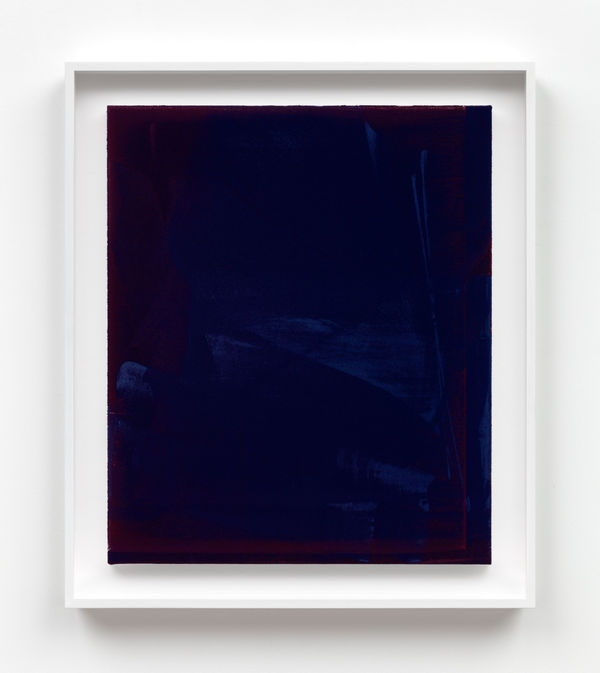
Overall, the works are intricate, complex, and layered, whether in development, technique, or outcome—revealing themselves through repeated motions and careful consideration. Suggestions of screens, architectural references, and windows recur throughout, opening up mechanisms for viewing and ways of seeing, while going beyond the visible. Dan Walsh’s Channel (2020) in the gallery’s main space offers a schematic, almost an infrastructure to build on. A series of distinct color fields extends into the adjacent space, with monochrome, though subtly intricate surfaces like those found in works by Iulia Nistor and Paul Czerlitzki. Here, a work by Toulu Hassani arises from a particular preoccupation with systems—likewise oscillating between complexity and simplicity, hinting at a grid while breaking away from its rigid structures. Repetitions and irregularities, through screens and structures, also carry through the works by Marieta Chirulescu. Nearby, Hermann Melville (2018-2019) by Nancy Haynes is dominated by black, with a sleek central gradient framed by more disorderly brushstrokes along the top and bottom edges. It initially appears as though light is reflecting off of the blank screen of some device, or emanating from below like a scanner – perhaps referring to an image that has already vanished, or has not yet emerged.
Similarly illuminated, Jonas Weichsel’s Tc Dia (2024) becomes an immersive, nuanced color space composed of much more than the two colors indicated in its title only on closer inspection. Here, the paint has been precisely and steadily applied by a wide brush that moves across the surface in a mechanical motion reminiscent of a printer or scanner. Across from Weichsel’s work, Wade Guyton’s Untitled (2020) also employs digital processes and media, enacting a similar distancing from the painterly gesture. Printed onto linen is an image of an image on a partially folded-over set of sheets—a work in progress—strewn on the studio floor. The pattern of its digital graphics, like that of a QR code, and the overall form of its movement almost resemble a brushstroke, falling somewhere between gestural and mechanized. Systems and processes of mark making are thematized and reconsidered by Jonathan Lasker and David Reed, too, through bold colorations that also emphasize the viscosity of paint.
The artist’s studio as a space for thinking and raising questions about painting, for its ongoing processes of production, and for the accumulation of pictorial knowledge, is conjured throughout the exhibition—from a sort of index of colors, like cards pinned to a studio wall, to a mapping of possible frameworks from which marks can be made or understood. The works refer to and reflect on the methods of their own making: whether the behavior and application of paint, of color, the effects of light, the production of marks.
At times, marks seem to pick up in one place and leave off somewhere else, like an unfinished thought left hanging in the air. A buzzing energy is built up through the relationships between the works and their positions in the space, allowing these thoughts to be amplified and bounced off one another. While wall paintings by Friederike Feldmann and Ernst Caramelle even enact a physical expansion of the pictorial field. There’s a direct, unmediated quality – an invitation to join an open-ended discussion. The painterly space, within the works themselves and extending into the exhibition as a whole, remains open and fluid, experiential in nature – imbued with the time it takes to reveal itself fully.Text by Julianne Cordray
-
安装图示
-
作品
-
-
Inquire about works in Pictorial Resonance


![Kerstin Brätsch Unstable Talismanic Rendering [Poliʻahu's Cure] with gratitude to master marbler Dirk Lange, 2016 Ink and solvent on paper, neon tubing 275.3 x 182.9 cm 108 3/8 x 72 in](https://static-assets.artlogic.net/w_600,c_limit,f_auto,fl_lossy,q_auto/artlogicstorage/galeriethomasschulte/images/view/d418e2726529bec636a48b60f40e140bj/galeriethomasschulte-kerstin-br-tsch-unstable-talismanic-rendering-poli-ahu-s-cure-with-gratitude-to-master-marbler-dirk-lange-2016.jpg)